#32

A friend and I recently watched the documentary Machines (2016), directed by Rahul Jain. She had brought chips for us, but we ate them very slowly and then stopped – it didn’t feel right to disrupt the spaces of silence in the film. Machines is a documentary about textile mills and the foul conditions in which the migrant labourers work. Dirt and grime, clanky machines, sweaty and tired bodies, and vats of gluey dye are juxtaposed with clean, large swathes of cloth and coils of textile being fished out of steam boilers. The visuals do most of the work, there is minimal dialogue – mainly reflections by the workers. The film doesn’t preach or try to resolve anything. I watched it just a few days after watching Homebound (2025), which is also partly set in a textile mill, and the timing felt incredible. I’m so grateful that Himal Southasian made it available to stream as part of their Screen Southasia project (it’s on view till Oct 8.)
This evening, I attended an online Q/A session that the magazine had organised with the director. There is a scene towards the end where several workers crowd the camera and confront the filmmaker, asking him how his film will help them or improve their lives. I asked on the chat if such interactions with the workers had occurred often while making the film. Jain’s response was bracingly honest. The workers rarely talked this way. But one morning, he said, when their shifts were changing and people were coming in and going out, he started talking to a few workers and made statements about how they simply wasted the money they earned on booze and so on. They could’ve gotten upset, he said, understandably so, but they trusted his intentions and instead really opened up to him. It’s a difficult and vulnerable moment for the filmmaker – I was surprised that they didn’t edit it out. It is true that the documentary will do nothing to improve their material conditions. But at least it prevents one from harbouring certain delusions about the society one lives in. In an interview with Variety, Jain says that people would sometimes ask him why he was making this film – if he wanted to see poverty he could just step out onto the streets – and yet, “People think the distance between the classes is two millimetres. They think it’s close, but it’s millions of miles. I was trying to shorten this distance.”
I have missed writing a lot. For all these months I thought, what good are these reflections about my life when cruel men are razing innocent, vulnerable people to the ground. But I have to live with myself, and I can’t do that if I’m not writing. Especially because when I’m not writing, I am also not doing the many things that happen in the background – at least not with any seriousness – such as reading, looking at art, listening to music, making connections that surprise me with their small revelations, and assembling beautiful, meaningful, moving things into a coherent fragment. This is why I want to write more often and share a little more.
I read the essay “The listening gift” by Faith Lawrence on Aeon a few weeks ago, and parts of it resonated deeply. I particularly loved the description of poet Rainer Maria Rilke’s reaction to the invention of the phonograph. Lawrence writes about how Rilke lived in a period of great technological change – he had grown up in one aural age and would spend the rest of his life in a different one, in which a voice could travel around the world through a telephone, and be reproduced and continue to exist long after the owner’s death through the phonograph. She quotes Rilke’s experience of learning how to make a primitive phonograph in school:
“The sound which had been ours came back to us tremblingly, haltingly from the paper funnel, uncertain, infinitely soft and hesitating and fading out altogether in places. Each time the effect was complete. Our class was not exactly one of the quietest, and there can have been few moments in its history when it had been able as a body to achieve such a degree of silence. The phenomenon, on every reception of it, remained astonishing, indeed positively staggering. We were confronting, as it were, a new and infinitely delicate point in the texture of reality, from which something far greater than ourselves, yet indescribably immature, seemed to be appealing to us as if seeking help.” – from “Primal Sound” by Rainer Maria Rilke, in Rodin and Other Prose Pieces (1986), translated by G Craig Houston
What an amazing feeling this must have been – how strange and intriguing and exciting! I tried to remember if I have felt this way in recent years, and drew a blank because all I could think about was AI. (I am tempted at this point to rant about AI but shall refrain.) Regardless – the most beautiful thing that followed my reading of Lawrence’s essay was an experiment that some friends and I conducted. It was inspired by the ‘Spaces for Listening’ project that consultants Brigid Russell and Charlie Jones initiated during the lockdown, which Lawrence describes as a practice in which participants gathered online and shared a “secular, lightly ritual space.” My friends and I followed the same process wherein we took turns to speak, in response to the basic guiding prompts, and as Lawrence writes, it was “unusual to be able to share our thoughts in public with the confidence that no one will interrupt, and to be given permission to listen with no obligation to respond.” It led to an astoundingly balanced and respectful expression and reception of what each of us was thinking about and how we felt about what the others had said. Unlike in heated debates (charming as they are in their own way), specific emotions did not dominate the discussion or influence our responses, and it was just an incredibly calming experience. I hope to participate in many more of these with many dear friends.
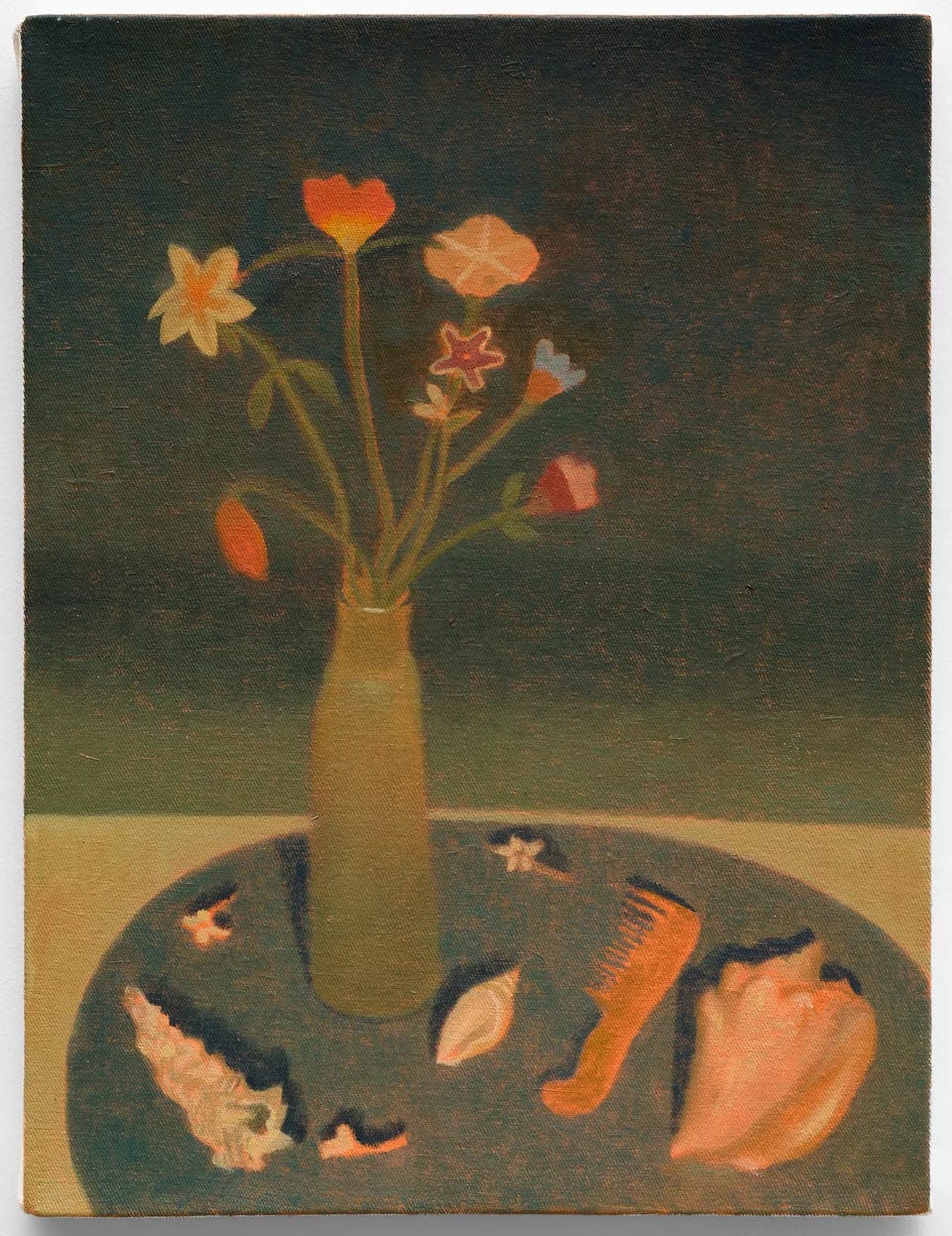
Other things I have enjoyed: Crying Glacier by Lutz Stautner – a short film about a slowly dying phenomenon – at Emergence Magazine, revisiting T S Eliot’s poem “The Love Song of J Alfred Prufrock” and falling in love with it all over again (not to mention that it was read to me so beautifully that the sound of it perfumed the air long after the poem had ended), and finally, the light and elegance in this painting – Flores da noite (2022) by the Brazilian artist Paula Siebra.
I took my sweet time reading this. I have missed you
It’s so good to see you back. I love this fresh format and how seamlessly you tied everything together. I watched Homebound too recently and will definitely watch the other film. These films are powerful. And I’m going to look up phonographs: didn’t know anything about it. Thank you!